Before the Close-Up: How Early Films Made Faces Legible
See how early films made facial expression readable through gesture, staging, and framing, and learn what a close-up adds to a scene’s visual storytelling.
How did early films make a face readable before a close-up arrived? In early films, facial expression could register through the whole frame: a performer’s orientation, a clear gesture, or the spacing between bodies. The effect varies from film to film, so it is more useful to study a specific scene than to treat silent cinema as one uniform style.
Choose one short silent film or a few scenes and watch them with a different visual question each day. The aim is not to rank old films against current habits, but to notice how staging and framing carry expression before a face fills the screen.
Wide-frame reading
Choose a film with continuous scenes and, if possible, a version that preserves the original framing. A public-domain comedy, melodrama, or actuality film can work; avoid beginning with a heavily edited compilation, where cuts may rearrange the scene’s visual logic. Watch once without pausing, then replay a scene and attend to bodies rather than plot.
In some early films, performers face the camera or turn so their features remain visible. That is not a rule for every scene or performer. It is one way to make information legible in a broad image, especially when several figures share the frame. A lifted hand, a recoil, or a turn can carry emotional weight when the body is clearly presented.
Note where each performer stands, which way the face points, and whether another figure blocks the view. A quick sketch can help: draw the frame, mark each performer, and add arrows for their gaze. Readability is not only an actor’s task; camera position and composition shape what the audience can see.
Gesture and expression
Follow one performer through a short scene. Notice the size and timing of gestures. A hand pressed to the chest, a palm held outward, or a sudden turn away may seem emphatic to a contemporary viewer, but in a wide shot such actions can make a reaction easier to follow.
Separate what the body does from what you infer. Write “shoulders drop; eyes turn toward the doorway” rather than “the character feels defeated.” The first note describes visible evidence and leaves room to ask how the scene guides interpretation.
Then consider the full composition. A gesture may point toward a letter, another person, or an exit. The face is not an isolated sign: it belongs to a body acting in a designed space.
Staging reactions
Pick a scene with at least two people. Pause after a major movement and ask who occupies the clearest position. Does one performer stand forward while another remains behind furniture? Does someone turn outward to make a reaction visible? These arrangements can clarify relationships before a closer view appears.
Entrances, exits, and held poses can also clarify who has seen what. A character might turn toward the audience after noticing a secret, giving viewers access to the reaction. Detached from its framing, the performance may seem broad; within the scene, the pose may keep a face visible while the action remains legible.
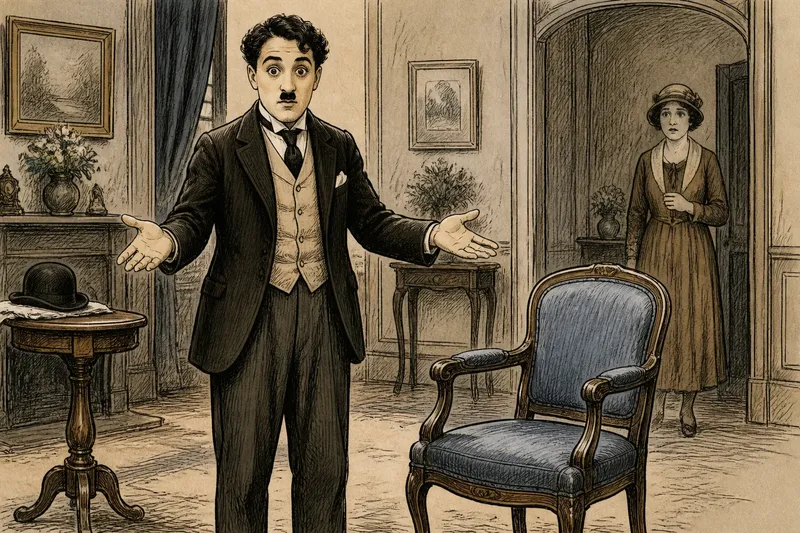
Imagine a silent comedy scene in which a visitor finds an empty chair where a host was expected. The performer looks at the chair, turns toward the camera, and spreads both hands. Viewers can follow the discovery and read the comic reaction without a close-up. The arrangement and gesture work together to make the face legible at a distance.
Framing the face
Compare a wide view with any closer view in the film. Ask what the closer framing adds instead of assuming it simply intensifies emotion. It may reveal a small change around the eyes, isolate a reaction from busy action, or shift attention from a group’s movement to one person.
Some early films use closer framing sparingly; others vary distance more freely. Do not treat one film as a universal rule. Genre, production choices, camera practice, and the condition of surviving prints all affect what you see. If a film contains no close-up, that absence can still be instructive: the story may rely on gesture, blocking, intertitles, or repeated visual patterns.
Describe a close view by its job: “isolates the glance,” “shows a hesitation,” or “keeps the object and face in view.” Then compare that with what the wider shot communicated. A face can be expressive in a long shot, while a close-up can withhold as much as it reveals.
Distance and detail
Choose two scenes from the same film, one that keeps performers at a distance and one that brings a face nearer. Watch them back to back. The distant scene may show relationships through spacing and movement; the closer scene may make a fleeting reaction easier to notice.
Also track what disappears when the frame tightens. A close-up may hide hands, other performers, or the setting that gave a gesture its meaning. A broad view can make subtle facial changes difficult to see. Neither distance is automatically more expressive; each distributes information differently.
Write one sentence about what the wide shot shows and another about what the close-up shows. If both sentences say only that the character’s feelings are clear, look again. Perhaps one shot shows who is watching, while the other reveals whether the character reacts before or after being seen.
Attention and intertitles
Watch a scene without pausing and notice what draws your eye first. If the version includes musical accompaniment, replay it with the sound muted to focus on visual cues; do not assume this reproduces the conditions of every early screening. A moving body, a bright prop, an entrance, or a face may lead your attention.
In a wide composition, a face can stand out because the film clears space around it or gives it a distinct movement. A performer who stops while others continue may attract attention without a cut. A reaction near the center of the image can do the same.
Notice whether an intertitle changes how you read the next expression. Text may name a thought or clarify a situation while the image supplies a visible response. When both appear, the face does not have to communicate every detail alone.
Questions about faces?
Why did some performers face the camera?
Facing the camera could keep a performer’s features visible in a broad image. It could also help gestures and reactions register without relying on a close view.
Did early films never use close-ups?
No. Closer framing appeared in early screen storytelling, but its use varied across films and scenes. Ask what a particular close-up directs viewers to notice that the wider frame does not.
Why can silent-film acting look exaggerated?
Large gestures and held expressions can remain readable across a frame, particularly when several actions compete for attention. Performance styles varied, so one scene should not stand in for every silent film.
How can I compare different versions of a film?
Check for changes in cropping, playback speed, tinting, intertitles, and added music, all of which can affect how a scene feels. If the source version is uncertain, describe the visible choices in the copy you have rather than treating every presentation detail as original.
Early films made faces legible through different combinations of bodies, space, and camera distance, not through one universal formula. On your next viewing, start with the full frame before seeking the face: the surrounding scene often explains why a close-up matters when it arrives.