A Scene Has a Destination: What Character Goals Do
Learn to identify a character’s immediate scene goal, separate it from the story’s larger purpose, and diagnose why a scene feels stalled or unfocused.
What does the character want before this scene ends? That question often reveals why a scene has direction—or why it feels like people are simply waiting for the next plot event. A character goal gives a scene a destination: an immediate result someone is trying to bring about, avoid, or secure.
That destination is not necessarily the story’s larger purpose. A detective may be trying to solve a case across a film, while in one scene she wants a witness to stay in the room long enough to answer a question. The larger aim gives the story its broad trajectory; the immediate goal gives this encounter something to push against.
When a scene feels inert, vague, or strangely disconnected, the trouble may lie in how its goal is framed. The useful fix is not always to add a twist. First, work out what the character wants here, how the scene makes that want visible, and what changes if the character does not get it.
Goals at Two Scales
A story-level purpose may be broad, lasting, and shared across many scenes: expose a fraud, repair a family bond, or get home. A scene-level goal is narrower and bounded by the present encounter: persuade a sibling to lend the car, hide a letter before a visitor arrives, or get a guard to open a gate.
The smaller goal should connect to the larger purpose, but it need not repeat it. A character pursuing a homeward journey might need a stranger to share a map. In that scene, the immediate goal is to obtain help, not to “get home” all over again. Naming the smaller aim lets a writer judge whether the encounter has its own shape.
Goals can be private or openly stated. A character may announce, “I need the keys,” or quietly try to keep someone from noticing that the keys are missing. The goal is the result the character seeks, not necessarily the words spoken aloud and not necessarily a noble or sensible result.
When the Goal Feels Vague
A common problem is a goal that sounds more like a topic than an intention. “Talk about the old house” identifies what a scene concerns, but it does not say what anyone wants to happen. Without that distinction, a scene can drift among memories, explanations, and reactions without a clear point of pressure.
The cause is often a goal written at the wrong level of abstraction. Words such as “understand,” “connect,” or “deal with” can describe a broad emotional need, but they do not always suggest an action the audience can follow in a particular exchange. Ask what the character hopes another person will do, what they hope to prevent, or what concrete decision they want made now.
Try this: rewrite “Mara wants her father to understand her” as “Mara wants her father to let her keep the rehearsal space open until the weekend.” The revision does not erase the emotional need. It gives that need a visible point of contact: he can agree, refuse, postpone, or offer a different arrangement.
For a scene goal, look for a result the character could recognize as achieved or blocked. If there is no imaginable moment when the character would know the attempt worked, the goal may still be too hazy.
When the Goal Is Too Large
Sometimes a scene feels as if it is carrying the entire story on its back. The protagonist wants to win the election, save a community, forgive a parent, and discover who they are—all before the scene ends. Those aims may belong to the story’s larger arc, but piling them into one moment makes it hard to tell what the character is trying to accomplish right now.
This usually happens when a writer confuses importance with scale. A scene can matter enormously without having a sweeping immediate goal. A choice to keep a document rather than surrender it may be small in physical terms and consequential in the story. The scene’s weight comes from what is at stake in that choice, not from giving the character several enormous aims at once.
Try narrowing the goal to the next decision or interaction. If the character’s larger objective is to expose a corrupt official, the current scene might be about getting a clerk to confirm a spelling on a form. The modest request can carry tension because of its connection to the larger purpose, while remaining clear enough to play moment by moment.
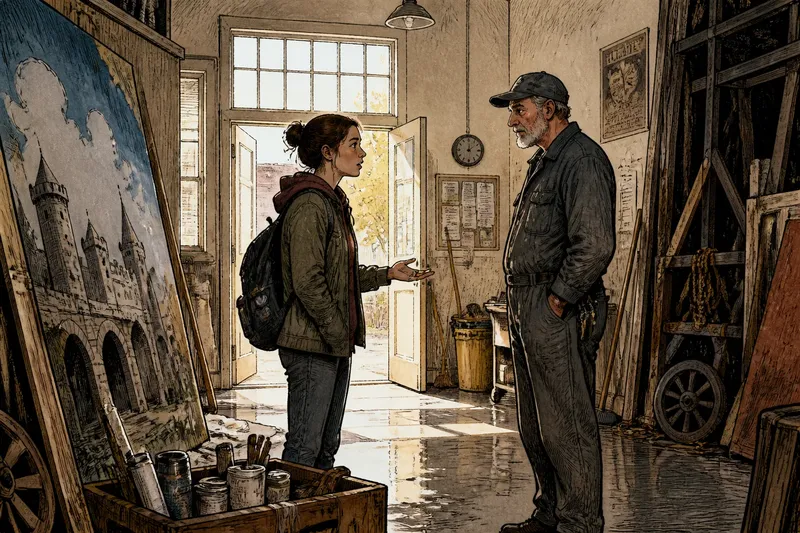
Imagine a student hoping to save the school theater across a story. In one scene, she wants the custodian to let her retrieve a painted backdrop before the room is cleared. If he agrees, she gets the backdrop; if he refuses, the loss is immediate and observable. The scene need not also settle the theater’s future.
When the Goal Is Invisible
A scene can have a clear goal in the writer’s notes and still leave the audience unsure what anyone wants. This often happens when the intention exists only as background information. The character’s behavior gives no readable connection between the goal and the choices unfolding on screen.
Look for a pattern of attempts. Does the character ask, conceal, bargain, wait for an opening, change tactics, or try to redirect another person? These actions can make a goal legible without a character explaining it. The audience does not need certainty about every motive, but it should have enough evidence to follow what someone is trying to achieve.
If the scene’s central attempt appears only near the end, consider whether an earlier action could point toward it. A character who needs a signature might place the form where the other person can see it, then bring it up when the conversation turns to the deadline. A character trying to prevent a departure might keep introducing reasons to stay. The audience can read these attempts as movement toward an immediate result.
This does not mean every gesture must be a clue. Ordinary behavior can remain ordinary. The question is whether the character’s effort to get somewhere is visible often enough that changes in the scene register.
When the Scene Goes Nowhere
A character can have a clear goal and still make the scene feel static if nothing meaningfully interferes with it. The cause may be an attempt that succeeds too easily, repeated discussion with no new decision, or an obstacle that never changes the character’s options.
Try tracing the goal through the encounter: what does the character attempt first, what response do they get, and what do they try next? If every attempt produces the same kind of answer, the scene may need a changed tactic or a more revealing consequence—not simply louder emotion. The other person might agree to help only if the character admits why the request matters. A delay might force the character to choose between waiting and leaving without the thing they came for.
Not every scene needs a fight, a deadline, or a dramatic reversal. Resistance can come from another person’s competing aim, the character’s own hesitation, an awkward social constraint, or a practical limit. What matters is that the character cannot simply collect the desired result without encountering a choice.
When a scene stalls, check whether the character has tried more than one way to reach the goal and whether each response changes what they can do next.
When the Goal Keeps Shifting
A scene may begin with one apparent aim and then wander among several unrelated ones. The character wants an apology, then a ride, then an explanation, then a chance to leave, while the scene gives no signal that one aim has replaced another. The result can feel like a sequence of disconnected conversational turns.
Goals can change during a scene, and a change can be its most important turn. The trouble is not the shift itself; it is a shift that has no cause the audience can recognize. A new fact, refusal, offer, or emotional admission can redirect what the character wants. When the goal changes, let the new aim take over the character’s next effort.
Say a tenant enters a meeting hoping to get permission to paint a hallway. The building manager reveals that the hallway will be inspected before any painting is considered. The tenant may then shift to asking for a date for the inspection. The new goal follows from a concrete obstacle, so the scene changes direction without losing coherence.
If several aims remain active, decide which one organizes the scene and which ones are secondary. A character can want two things at once, but the audience benefits from knowing which desire is shaping the current choice.
Questions About Scene Goals?
Can a scene have more than one goal?
Yes, especially when characters want different outcomes from the same encounter. Still, identify the main effort that gives the scene its direction; other desires can compete with it or complicate it.
Does the character have to say the goal aloud?
No. A stated request is one way to make intention clear, but repeated attempts and choices can do the same work. Let the audience infer the goal from behavior when that inference is meant to create interest.
What if the character does not know what they want?
Confusion can be the point, but the scene still benefits from something the character is trying to avoid, test, or postpone. A character who cannot choose may want to keep two options open, even if they cannot admit it.
How is a goal different from a scene’s purpose?
The goal belongs to a character: it is the result they pursue in the encounter. A scene’s purpose describes what the scene contributes to the larger story, such as changing a relationship or revealing a new constraint.
Find the Destination
To identify a character’s immediate goal, name the result they want before the encounter ends, then separate it from the broader aim that carries across the story. Check whether the character’s attempts make that result visible, whether resistance forces a choice, and whether any change in direction has a recognizable cause.
A scene goal does not need to be grand, spoken aloud, or achieved. It needs to give the character a destination close enough for the audience to watch them pursue it. If a scene feels unfocused, start by naming that destination in plain language; the next useful revision often becomes easier to see.