A One-Scene Rewatch: Track Where Each Cut Sends Your Attention
A one-scene rewatch helps you see how cuts redirect attention, clarify action, or change pacing, without turning every edit into a hidden message.
What does each cut make you look at next? A one-scene rewatch turns that question into a compact viewing exercise: follow the shift in your attention, then ask how the shot order and duration shape what you notice. The aim isn’t to decode every edit as a secret signal. It’s to see how editing guides a scene’s flow.
Pick a scene you can replay easily, ideally one with a clear exchange or physical action. Watch it once without pausing. On the second viewing, focus on the cuts—not the whole plot—and choose a method that suits how closely you want to examine the scene.
Three viewing approaches
There isn’t one correct way to track a cut. A quick attention pass keeps the exercise light; a shot log makes patterns easier to compare; a duration pass highlights rhythm. Each answers a different question.
- Attention pass: Best for a first close viewing or a scene with brisk dialogue. At each cut, note what draws your eye or ear: a face, a moving hand, a doorway, a new voice, or a sound that continues across the transition. Keep notes brief.
- Shot log: Best when the scene’s order feels confusing or unusually controlled. Record each shot in sequence, with a plain description such as “wide shot, both characters at the table” or “close shot, one character looks toward the door.” Add what changed after the cut.
- Duration pass: Best when pauses, reactions, or bursts of action seem to set the pace. Replay the scene and compare how long shots seem to hold. You don’t need exact timing; note which moments feel brief, sustained, or interrupted.
Choose the attention pass for immediacy, the shot log for clarity, or the duration pass for rhythm. If you’re unsure, start with attention and add a short shot log only if a sequence remains hard to follow.
What changes at a cut
A cut may change the subject, the distance, the angle, the location, or simply the moment you’re seeing. It may move from a speaker to a listener, from a hand reaching for a cup to the cup itself, or from an action to its result. Sometimes the image changes while a sound continues, so listen as carefully as you look.
On your attention pass, describe the change before interpreting it. “The frame moves from the speaker’s face to the listener’s hands” is an observation. “The listener is hiding something” is a possible story reading, but the edit alone may not support it. Separate what you can point to from what you infer.
Also notice when a cut doesn’t redirect your attention much. A sequence of similar framings may keep a conversation visually steady, while a sudden change in scale may make a small gesture easier to notice. Neither choice has a fixed meaning; its effect depends on the action, performance, sound, and what came before.
Order and duration
Shot order controls when the viewer receives information. A scene might show a character glance offscreen before revealing what caught their eye, or show the object first and then the character’s response. The same elements can feel different in a different order: the viewer may anticipate, recognize, or only later understand what matters.
Duration affects how long you can inspect a moment. A held shot may leave room to notice a shifting expression or activity in the background. A brief shot can register as a glance, a detail, or a quick link between actions. But don’t assume that a long shot always signals importance or that a short one is disposable. Check what the scene gives you time to see.
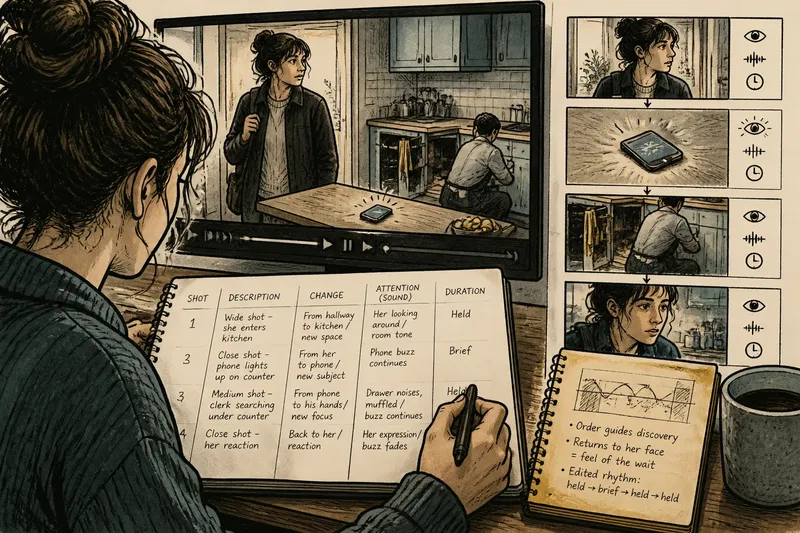
Imagine a scene in which someone enters a kitchen and hears a phone buzz. On one viewing, the cut goes from the character’s face to the phone lighting up, then back to the character. On another, the phone appears before the character enters the frame. The first order may let you share the discovery; the second lets you anticipate the interruption. Those are plausible effects to test against the scene, not coded meanings you must assign.
Keep a small shot log
A compact log is enough to reveal how a scene parcels out attention. Use a notebook or a plain text document, and write one line for each shot. Keep the language concrete so you can revisit the sequence without turning your notes into a verdict.
- Write a neutral description of the image: “two people in a hallway,” not “a tense confrontation.”
- Note the main change at the cut: subject, framing, location, action, or time.
- Record where your attention goes first, including any sound that leads or continues across the cut.
- Mark the shot’s apparent duration as brief, held, or somewhere between.
- After the scene, identify one sequence where the order or duration altered what you noticed.
Say you choose a short scene in which a customer waits at a counter while a clerk searches beneath it. Your notes might show that the edit repeatedly returns to the customer’s face, while the clerk’s hands remain out of view. On a later pass, you could check whether that pattern makes the wait feel more uncertain, or simply keeps the customer’s reaction visible. Either observation is useful; neither needs to become a claim about hidden intent.
Reading cuts with care
Editing works with other parts of the scene. A glance may draw attention because of the actor’s performance, the camera’s framing, a sound cue, or the cut that places those elements together. Try to name the contribution you can see or hear before attributing the whole effect to editing.
Be alert to continuity as well as emphasis. A cut can make an action easy to follow by connecting a movement across shots. It can also skip time or shift position, asking you to fill in what happened between images. If you lose track, rewind just far enough to compare the action before and after the transition.
One scene can support several reasonable readings. If a cut seems pointed, ask what else it accomplishes: does it clarify who is speaking, preserve a reaction, keep an action legible, or let a sound bridge two images? A practical interpretation accounts for the scene’s visible mechanics without insisting that every choice carries a private message.
Questions during a rewatch?
How many times should I replay a scene?
One uninterrupted viewing and one focused pass are enough to begin. Replay a short stretch only if you need to check the order of shots or confirm what changes at a particular cut.
Should I pause at every cut?
Usually not on the first close viewing. Let the scene play so its pacing remains intact, then pause or rewind when a transition is difficult to track.
What if the cut seems to change nothing?
Record that impression and look for a quieter function, such as maintaining continuity or keeping a listener’s reaction in view. Some cuts do not create a strong, distinct shift in attention.
Can sound change what a cut feels like?
Yes. A sound may begin before the image changes or continue after it, linking shots that look different. Note whether the sound draws you toward the new image, carries you across the cut, or remains secondary.
Choose your next pass
When the scene ends, return to your original question: where did each cut send your attention? Use the attention pass if you want a quick map, the shot log if you want a clear sequence, or the duration pass if rhythm is what you’re trying to understand. The one-scene rewatch works best when your notes stay specific and your interpretations stay open.
For a useful final check, watch the scene once more without pausing and see whether your notes help you notice a change you missed—not whether they produce a single definitive explanation. That keeps the exercise grounded in what the scene actually offers: images, sounds, and the order in which they arrive.